Master’s thesis · M.Sc. Human Factors · TU Berlin
Master’s Thesis
Social Inhibition of Return in Human–Robot Interaction: The Role of Belief in Teleoperation
- Experimental & Quantitative Research
- Human–Robot Interaction
- Reaction-Time Analysis
- Cognitive Psychology
- Python & NAO Programming
- Context
- Master’s thesis · M.Sc. Human Factors · TU Berlin
- My role
- Researcher · Experiment design, programming, data collection and analysis
- Timeline
- Submitted June 2026
- Collaboration
- Shared codebase and Human–Human study with a fellow master’s student; robot study and thesis completed independently
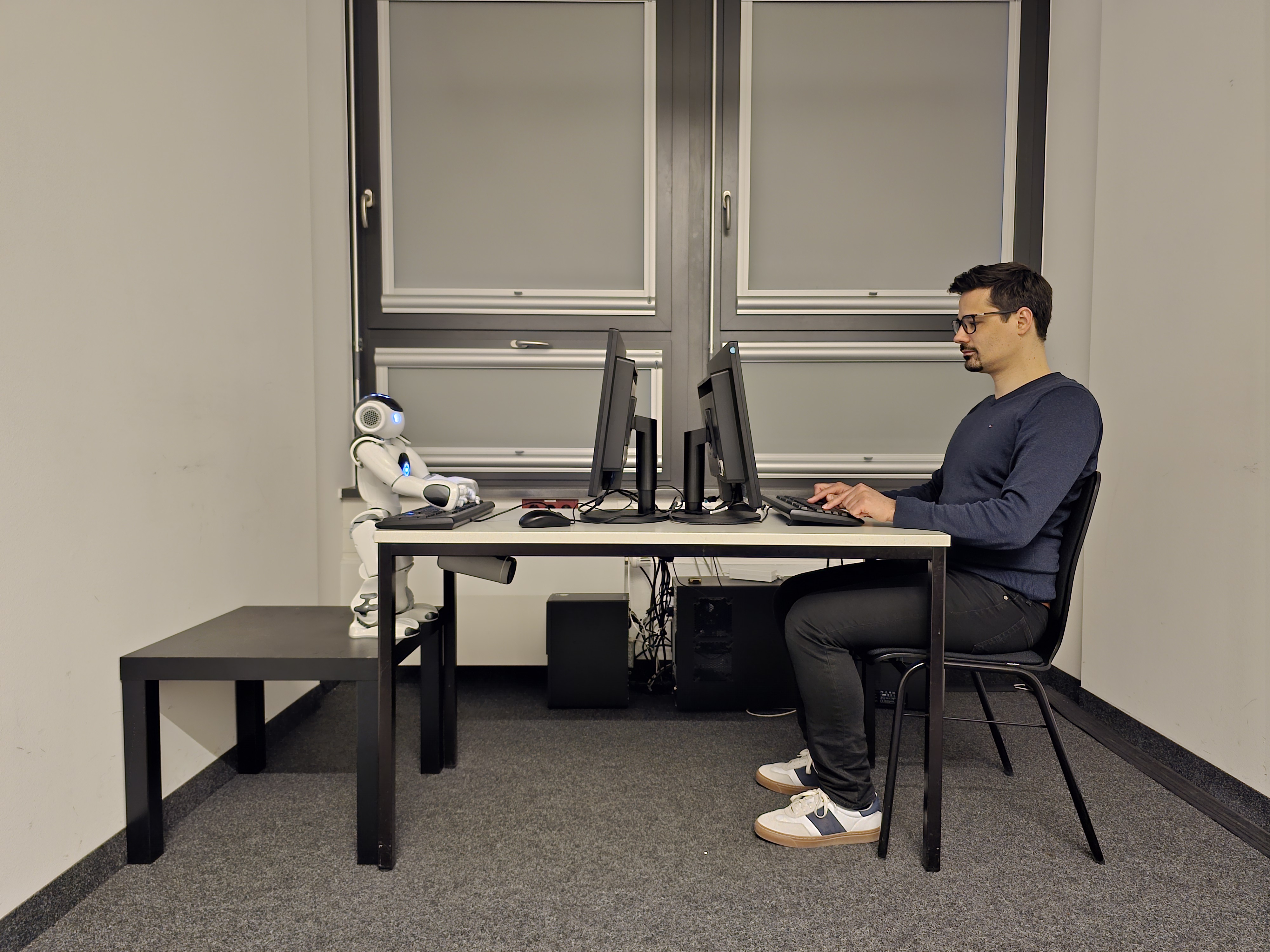
Laboratory setup used to develop and conduct the human–robot interaction study.
Why this research mattered
Context and challenge
Inhibition of return (IOR) is an attentional mechanism in which people respond more slowly to a location that has recently been attended. This tendency to avoid immediately returning attention to the same place is understood to support efficient visual exploration.
Social inhibition of return (sIOR) extends this effect to another actor’s focus of attention: after observing someone else act toward a location, responses to that location can also become slower. This makes sIOR an implicit reaction-time measure for investigating how another entity is processed as a social co-actor.
Human–robot interaction provides an interesting context for this phenomenon. A robot performs the visible action, while people may form different beliefs about the agency behind it—for example, whether its behaviour is autonomous or controlled by a remote human. My thesis connected sIOR with this question of teleoperation.
Because a manuscript is currently in preparation, the exact hypotheses, study design, and findings are not yet public. This case study therefore focuses on the conceptual background, my responsibilities, working process, and methodological skills.
Decisions and rationale
Research strategy
I developed a quantitative laboratory study that combined experimental psychology with human–robot interaction. Reaction-time measurement made it possible to investigate attentional processing beyond explicit opinions or self-report.
Teleoperation offered a particularly relevant HRI context: the visible co-actor was a humanoid robot, while the action could be attributed to a person operating it remotely. A central research challenge was therefore balancing precise experimental control with a credible social interaction.
My work covered the research design, technical implementation, standardized study procedure, data collection, statistical analysis, and scientific reporting. I treated the software, robot behaviour, timing, participant instructions, and quality checks as parts of one research system rather than as separate tasks.
From question to evidence
Research process
-
Frame the research question
Synthesise literature from cognitive psychology and human–robot interaction and translate a theoretical gap into a testable research plan.
-
Design the experiment
Develop a controlled quantitative study, define the measures and quality criteria, and prepare a standardized laboratory procedure.
-
Obtain ethical approval
Contribute to the ethics application, address the requirements for responsible research with participants, and help guide the study through review and approval by the responsible TU Berlin ethics committee.
-
Build the technical setup
Program the experimental task in Python, develop the robot-control software for the NAO robot, and coordinate stimuli, robot behaviour, turn-taking, and response timing.
-
Collect reliable data
Conduct the laboratory study independently, monitor the procedure, and document deviations and data-quality decisions consistently.
-
Analyse and communicate
Prepare and analyse reaction-time data, evaluate the evidence critically, and communicate conclusions together with their limitations.
Contribution and next steps
Outcome
The thesis received the highest possible grade in the German grading system (1.0). It demonstrates my ability to lead an experimental research project from theoretical framing through technical implementation and data collection to quantitative analysis and scientific communication.
A manuscript based on the research is currently in preparation for submission to a scientific journal. Detailed methods and findings will follow after publication.
Research quality
Reflection and limitations
One of my main learnings was how often research requires trade-offs. I had to balance the theoretically ideal design with what was appropriate for participants, technically reliable, and feasible within the available time and resources. Deciding where to invest effort and where to set priorities was therefore an important part of the research strategy.
I initially underestimated the programming effort because the experimental task appeared simple. In practice, trials had to be balanced, subtle errors were difficult to detect, and timing had to be precise at the millisecond level. The Python experiment, robot behaviour, communication between system components, and different edge cases all required extensive testing. I realised that the quality of the software directly affects the quality and validity of the research.
Although this was an individual master’s thesis, I worked closely with a fellow master’s student, my advisor, and other researchers. We challenged ideas, discussed methodological decisions and priorities, and supported one another with technical and strategic questions. This confirmed how strongly I value teamwork: I believe the best outcomes emerge when people combine perspectives, ideas, and complementary skills.
I used generative AI to support programming and debugging, data analysis and visualisation, and scientific writing and formatting. How useful it was depended heavily on the task and the clarity of my instructions. I learned to provide context, constraints, and success criteria from the start, as I would when briefing a colleague, so that an initial result is already purposeful. AI did not replace domain knowledge or scholarly judgement: the stronger my own understanding, strategy, and priorities were, the better I could evaluate, verify, and improve its output. Responsibility for all research decisions and final content remained with me.
 HF Chapter Berlin