Research project · HSLU Informatik × PHSZ · swissuniversities P-8
VKT Project
Designing synchronous online teaching through interdisciplinary research and practical guidance
- Qualitative UX Research
- Focus Groups
- Content Analysis
- Interdisciplinary Research
- Research Communication
- Context
- Research project · HSLU Informatik × PHSZ · swissuniversities P-8
- My role
- Researcher · focus-group study, moderation, qualitative analysis and synthesis
- Timeline
- 2022–2025
- Collaboration
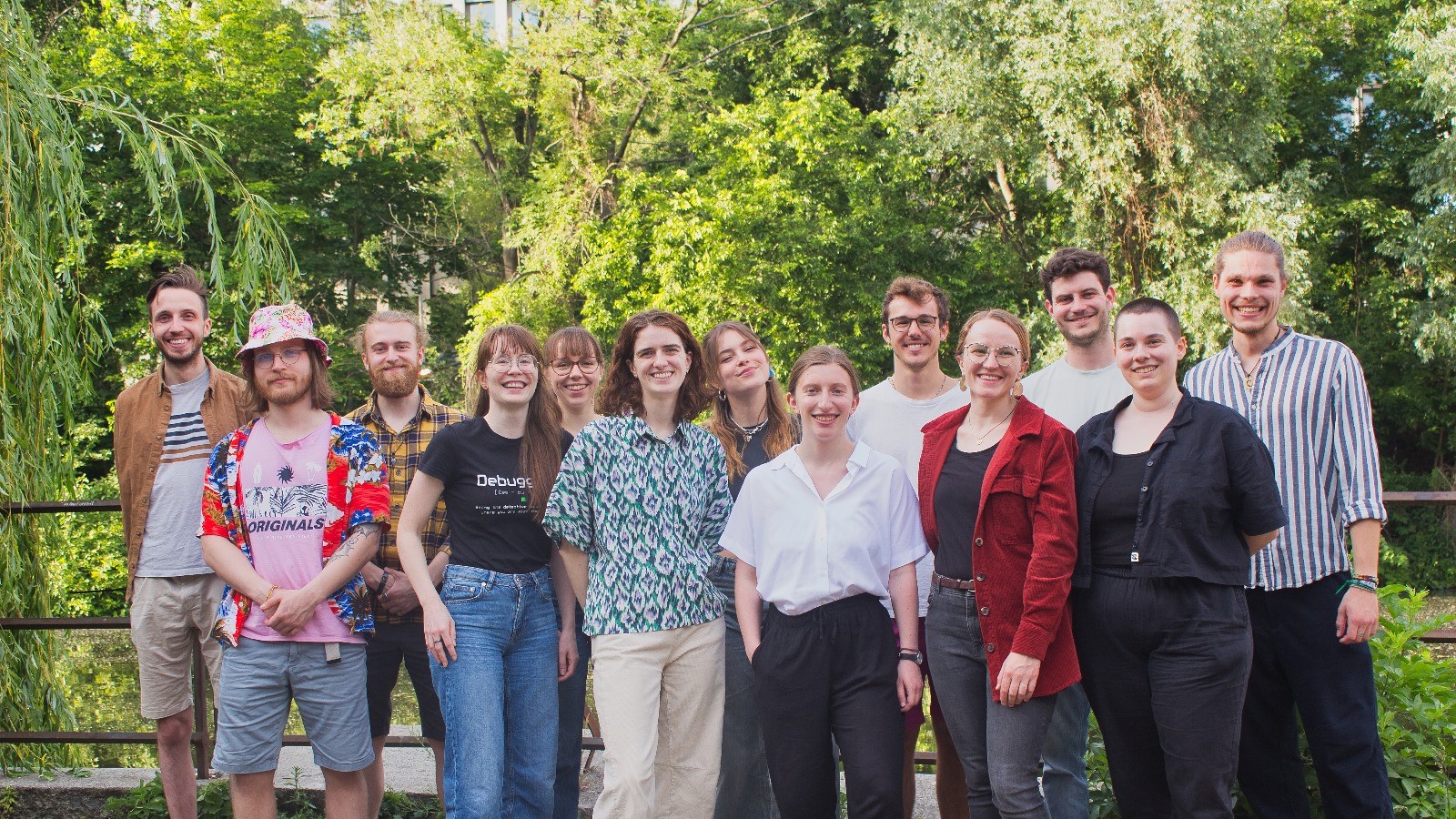
- Interdisciplinary team spanning UX, computer science, educational research, subject didactics and spatial sociology
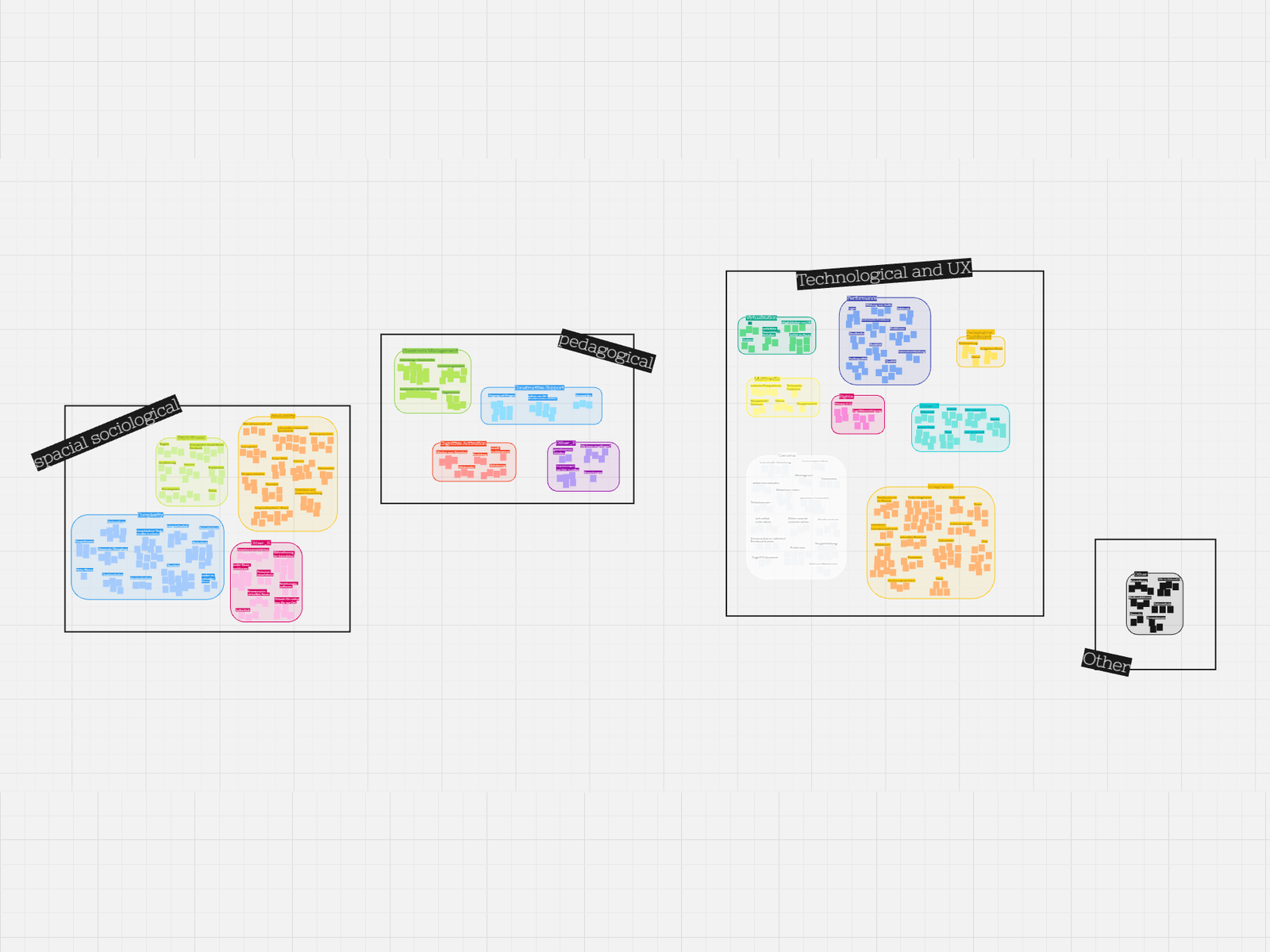
Digital analysis board grouping extracted focus-group passages into spatial-sociological, pedagogical, and technological and UX categories. The board is deliberately shown at overview scale so individual notes are not readable, helping protect participant privacy.
Research question
How can synchronous online teaching at universities be designed so that virtual learning spaces support effective, socially connected and usable teaching and learning?
Why this research mattered
Context and challenge
Most videoconferencing tools used in higher education were designed for meetings rather than teaching. Education has different goals, rules and interaction patterns, including the development of knowledge and competences. Using meeting-oriented tools for teaching therefore creates more than a usability problem. It changes how participants orient themselves, interpret social presence, manage attention and move between teaching formats.
The project examined synchronous online teaching across spatial-sociological, pedagogical, and technical and UX perspectives. Its purpose was to help lecturers work more deliberately with existing tools and to provide orientation for tools designed specifically for education.
The VKT project formed part of the broader P-8 programme “Digital Teaching, Digital Presence, Digital Studies”. Further information about the project’s institutional context, participating organisations and wider team is available in the official HSLU project record and on the P-8 programme website.
Decisions and rationale
Research strategy
My contribution centred on the empirical part of the project. In our subteam, we planned and conducted the focus-group study, analysed the material and synthesised its insights. The findings from our subteam were subsequently connected with those from the project’s other subteams and informed the resulting publications by the wider interdisciplinary team.
In our subteam, we conducted five two-hour focus groups with 26 students, lecturers and higher-education teaching experts from the Lucerne School of Computer Science and Information Technology and the Schwyz University of Teacher Education. Every session followed the same structure. Participants first shared experiences of online teaching and then responded to a magic-wand question about their ideal remote-conferencing tool. A 34-question interview guide helped us, as moderators, cover problems and possible solutions across different teaching settings.
Another researcher and I independently identified relevant passages in the reviewed and anonymised transcripts before assigning them to a deductively developed coding framework. Calibration phases, independent coding and consensus discussions helped us compare interpretations and develop a shared analysis.
From question to evidence
Research process
-
Frame the problem collaboratively
Connect user experience and technology with pedagogical and spatial-sociological perspectives on synchronous online teaching.
-
Recruit contrasting perspectives
Bring together students, lecturers and higher-education teaching experts from pedagogical and informatics contexts at two institutions.
-
Run structured focus groups
Use a consistent two-hour format, an experience-based opening, a magic-wand prompt and a shared interview guide across all five sessions.
-
Analyse the material together
Review and anonymise transcripts, identify key passages independently, calibrate the coding and resolve differences through consensus discussions.
-
Build the whole picture
Connect our subteam’s findings with the findings from the project’s other subteams, relate the combined evidence to research literature and develop an accessible guide and multidisciplinary framework for higher education.
What the evidence showed
Key findings
Make the rules of the online room explicit
Virtual rooms provide fewer implicit cues than physical classrooms. At the start, clarify how participants can ask questions, report technical problems and take part in discussions, as well as what is expected regarding camera use. Even small conventions reduce uncertainty, such as announcing a visit to a breakout room through the chat instead of entering without warning.
Why it matters: Lecturers and tools should make roles, participation options and communication channels clear instead of assuming that everyone interprets the online setting in the same way.
Design transitions and shared spaces
Moving into an online class or between tools and group formats can feel abrupt. Opening the room 10 to 15 minutes early and showing the session as a visible timeline can make transitions easier to follow. Shared documents and collaborative whiteboards also provide a persistent space where participants can see one another’s activity and contributions.
Why it matters: Transitions are part of the learning design. They need time, explanation and support rather than being treated as neutral technical steps.
Design interaction to support learning
Long input phases can be tiring online. Combining short inputs with interactive exchanges, movement breaks and quick feedback helps maintain attention and makes students’ learning more visible. Examples include emoji check-ins, shared feedback tools and private peer-to-peer chats that act as a digital whisper mode for quickly clarifying questions.
Why it matters: Social presence depends on how communication and shared artefacts are designed, not only on whether cameras are switched on.
Contribution and next steps
Outcome
The project translated interdisciplinary research and focus-group evidence into two public outputs: a practical guide published in 2023 and a multidisciplinary framework published in 2025. Together, they offer lecturers a reflection basis and concrete suggestions for effective synchronous online teaching, while also providing orientation for the future design of videoconferencing tools for education.
Research quality
Reflection and limitations
The two outputs are intended as reflection tools rather than universal rules. The appropriate design depends on the teaching format, learning goals, participants and institutional context.
A central lesson is that a virtual classroom should not simply reproduce a physical classroom feature by feature. Effective synchronous online teaching requires deliberate choices about participation, transitions, social presence, feedback and pedagogical purpose.
 HF Chapter Berlin